Lola and Finn's Mum

Lola and Finn's Mum
Showing posts with label red wine. Show all posts

Friday, 25 January 2013

In case the snow comes again (fingers crossed!) Venison Stew


Some people don't like snow. Luckily, I have firmly held on to my inner child and adore the stuff. If there is any better weather induced happiness than making the first footprint into virgin snow then I don't know what it is. Even lounging about on a sun lounger in the Mediterranean sun is only equal to the contentment I feel striding out through the white stuff. But then, in winter, I want snow. I expect snow. I am not a fan of three months of cold rain and grey cloud. And, because I am a subversive soul, I smile inwardly and outwardly at the chaos it brings. What's that? Snow day? Fabulous. Where's the sled?

The garden...
The oak tree...
The kids!
 
So if, like me, you have a penchant for sledging and snow in all its forms, you'll be wanting a meal to mind its own business, cooking away whilst you are busy outside pretending to be six or seven years old. And when you come in, hands stinging through cold, nose red, toes numb, glowing with youthful exuberance, your house will be alive and warm with the aroma of winey meaty stew. Your job will be to whip up a little bit of mountain of mash and some iron rich greens and then dish up. Wow. I sound organised.
 
I am frequently visiting Taylor's Farm Shop in Lathom, Lancashire and it was there that I found some diced venison which was cheaper per pound than the beef I was planning to buy. So, because I am, fundamentally, skint I decided on buying that instead, as well as my regular ham hock and about a tonne of steak mince. It was this Hugh Fearnley Whittingstall recipe that I had in mind when buying my meat when made, turned out to be a lovely light, but substantial dish. (Mash helps here, clearly!)
 
Lola and Finn's reaction? Well, after they'd thawed out they liked the dish in general. They really liked the gravy which though thinner than you might be used to, is really flavoursome. The meat is lean and benefits from the slow cooking indicated in the recipe. Finn even ate the cabbage and liked it. I imagine they will have nailed the lid on and I still won't have figured out what makes him tick when it comes to the food he chooses to eat. Crazy.
 
By the way, there is a distinct lack of pictures here and the reason is that I am 'between cameras'. I was bought a very jazzy technical camera for Christmas which is very nice but I still haven't figured out how to take pictures without blurring them. Anything that looks clear is through luck more than judgement. It also eats batteries like you wouldn't believe and that means I use my retired camera whilst my jazzy camera's batteries are charging. And then I forget I've done that. And then I delete them by mistake...
 
Venison Stew, adapted from Stewed Venison by Hugh Fearnley Whittingstall
 
(The quantities here are halved from the original recipe - enough to feed Lola, Finn, Mum and Dad)
 
Ingredients:
 
1 tbsp oil (or dripping)
125g salted pork belly or pancetta, cut into chunky cubes (I used diced pancetta)700g venison neck and shoulder meat, cut into large chunks (I used diced shoulder)1 onion, peeled and finely sliced
2 large carrots, peeled and cut into big chunks
1 sticks celery, sliced (I diced mine very small or those who don't like celery)1 bay leaf
1 sprig thyme (I used 1 tsp dried thyme)75ml red wine (I used a Cotes Du Rhone)250ml-plus beef or game stock (I used beef, and you need enough to cover the meat and vegetables) Salt and black pepper
 
Method:
 
Heat the oil in a large, heavy frying pan.
 
Add the pork and fry gently until it is lightly browned and the fat runs.
 
Transfer the pork to a casserole, but leave the pan and bacon-flavoured oil on the heat.
 
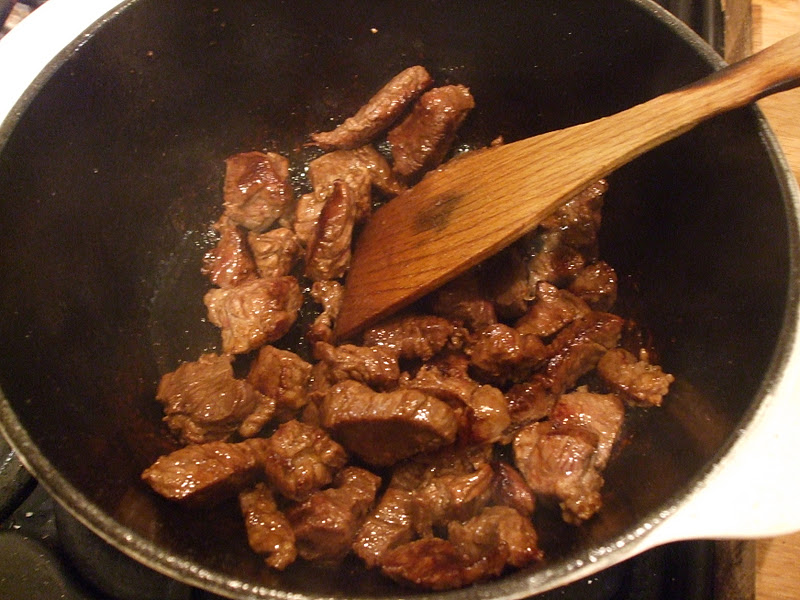
Now brown the venison, in batches, transferring it to the casserole as soon as it is lightly coloured.
Add the onions to the pan and sweat until soft but not brown.
 
Transfer to the casserole, then add the carrots, celery, bay leaves and thyme to the pan. Deglaze the pan with wine - allow it to bubble for a minute, to evaporate some of the alcohol.
 
Pour over the meat, along with the stock and a little water if needed: the meat should be covered by a good couple of centimetres.
 
Season sparingly with pepper, but not salt (the bacon will be quite salty).
 
Bring to a simmer and cook, uncovered, at a very low, tremulous simmer for one-and-a-half to two hours (up to three if you've used neck or shanks on the bone), until the meat is very tender.
 
(You can also cook it, covered, in a slow oven - about 140C/275F/gas mark 1.)
 
When the meat is cooked, taste the stew and adjust the seasoning. The juice will be thin, but well-flavoured.


Serve with a dollop of good, buttery mash and steamed seasonal greens.


Sunday, 20 January 2013

The best meal this year and Finn agrees! Lamb Ragu.


It's probably worth emphasising the fact that it is still only January, and the declaration in the title is subject to change. What isn't up for change is the fact that (trumpets please...) FINN LIKED THIS! Being that he is a finicky little bugger with a taste for the bland, the recognisable, the processed and, weirdly, shellfish and caviar (how can you put all those together in one sentence?) this is a momentous event. It is also one of the ways in which I am going to tell you that you must make this recipe because it is amazingly good. Honestly, it's wonderful!
 
The fact is that I would never have happened upon this recipe and more specifically the book that it came from if I hadn't found myself in TKMaxx looking for bedding. I was on a self enforced cookbook buying ban (I still am) but 'clearance' was next to 'bedding' and there this was battered looking, lonely cookbook dumped on a shelf within my line of vision. It was surrounded by the tat that TKMaxx have a cheek to try and sell, even though it is not fit for purpose such as chipped cups, photo frames without the glass, a pair of pillowcases with one missing - you know the type of thing, So, I picked it up. Price £2.00. It transformed from battered cookbook to orphaned child that was in need of a good home and consequently fell in my trolley. Yes, you're right. I am rambling.
 
So, the book is 'Urban Italian', an American book by Andrew Carmellini and save for a few Americanisms which I really don't understand, it contains some wonderful recipes which will now be tried due to the outrageous success of this one. I wondered how different lamb ragu would be in terms of taste and texture to 'normal ragu' if such a thing exists and it is different but I don't have the specific words to tell you how. If I can try, it's like this has a richer feel in the mouth and the components of the dish meld beautifully. I think, because it's lamb, I would be more than happy to serve this with potato as well as pasta. Without sounding like I have something akin to cooking OCD, I don't like putting normal ragu (read bolognese) with anything other than pasta. It doesn't taste right to me. Therefore, I served this with (shop bought) gnocchi because lamb and potatoes always go together, and they did. Next time I'll serve this with roasties and I don't care who thinks I am weird because it will taste fabulous.
 
Make this. You will not be disappointed.
 
Lamb Ragu, slightly adapted from Urban Italian by Andrew Carmellini and Gwen Hyman
 
( in cup measurements - American recipe)
 
My adaptions in red
 
Serves Lola, Finn, Mum and Dad, twice (so 6!) 
 
Ingredients:
For the ragu:
 
¼ cup olive oil
1 ½ pounds ground lamb (shoulder if possible)
½ cup finely diced carrot
½ cup finely diced onion
½ cup finely diced celery
1 tablespoon tomato puree
1 ½ cups dry red wine (I used Cabernet Sauvignon)
1 cup canned cherry tomatoes or good quality Italian canned whole tomatoes (I just used a tin of cherry tomatoes)
3 cups low-sodium chicken broth (or water) (I used lamb stock and put slightly less stock in to account for the increase in the quantity of tomatoes - see above)
2 bay leaves
½ teaspoon ground cumin
½ teaspoon ground coriander
½ teaspoon ground fennel
¼ teaspoon red pepper flakes
1 tablespoon fresh thyme leaves (I used dried)
1 tablespoon fresh rosemary leaves
Parsley stalks from the parsley I used to garnish later
½ teaspoon salt
¼ teaspoon coarse-ground black pepper
 
To finish the dish:
 
Gnocchi or pasta of your choice
2 tablespoons extra-virgin olive oil
2 tablespoons butter (didn't use it)
1/4 cup grated pecorino cheese (I used Parmesan)
1/4 cup chopped fresh mint (didn't use it)
A sprinkle of parsley
 
Method: 
 
Heat the olive oil in a large stew pot over medium-high heat. Ensure that it is big enough to brown all the mince at once, or else you will have to brown in batches. 


Cook the diced onion, carrot and celery. (PLEASE NOTE: This is different to the original recipe which suggests browning the mince and then adding the diced vegetables. Rightly or wrongly, I just prefer to do it this way round). 
 
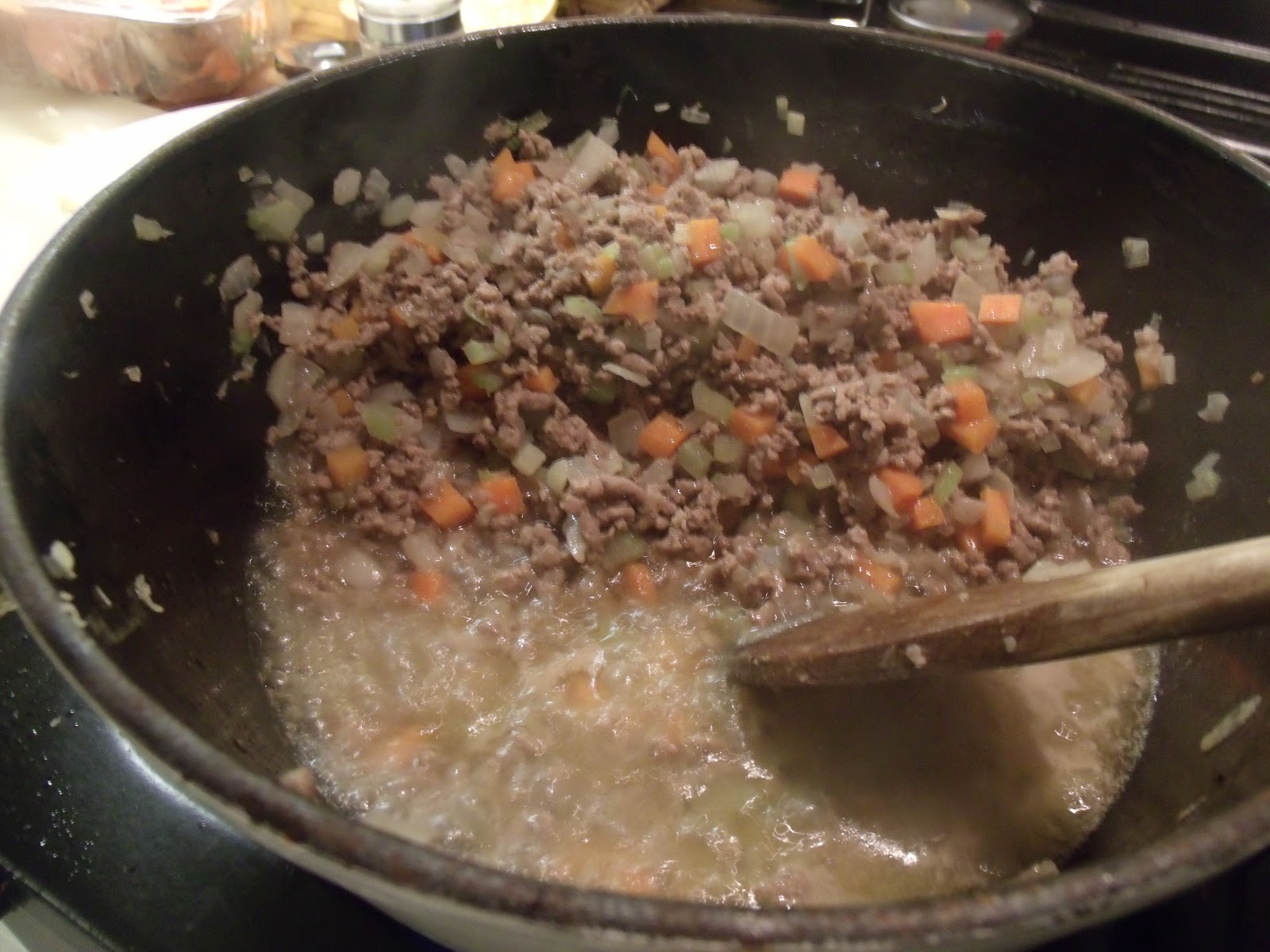
Just before I drained!
 
Add the ground lamb, breaking it apart into small bits as you drop it into the oil, and brown it over high heat, about 5 minutes. If the lamb releases a lot of liquid, so that the meat begins to steam instead of browning, just drain off the juice and put the pot back on the heat to start the browning process again.


Add the tomato paste and stir to incorporate. Cook together until the mixture becomes a thick reddish mix, about 1 minute.


Add the red wine and stir to incorporate, making sure that no bits of meat or vegetable are sticking to the bottom. Use a wooden spoon or rubber spatula to scrape down the sides; Cook until the wine evaporates completely: about 2 minutes.
  
Add the canned tomatoes and the broth (or water - or lamb stock). Then add the bay leaves, cumin, coriander, fennel, red pepper flakes, thyme, rosemary, salt, and pepper. Scrape down the sides of the pot again.


Bring the mixture to a low boil, and then reduce the heat to medium - low to keep the ragu cooking at a simmer. Cook the lamb, uncovered, until the liquid evaporates and the flavours meld, about 1 1/2 hours. Continue scraping the sides of the pot at regular intervals to avoid burnt bits. The meat will turn dark brown and the liquid will turn a dark orange colour as it cooks. When it's done, all the flavours will be melded, and the sauce (if you've broken the meat up enough) will look like a sauce: dark brown, rich, thick, and textured.
 
Cook the gnocchi or pasta of your choice.
 
Drain the pasta, add it to the sauce, and stir together over the heat, adding the olive oil, butter, and mint to make it smooth and rich tasting on the tongue. (I didn't do this)


Remove the pot from the heat, ladle the pasta and sauce into individual bowls, and top with the pecorino (or Parmesan) and parsley.
 
Enjoy, as Phill and I did, with the remainder of the red wine.

Tuesday, 11 December 2012

A meal designed for the depths of Winter - Braised Chicken with Onion and Bacon


Much as I like to try all kinds of different recipes and experience foods of different cultures, there is something soothing about the familiar and seeing as it is so cold outside just now, the idea of unpretentious, comforting food really appeals. You know the stuff I mean, simple ingredients, cooked with a bit of care and (if you're me) accompanied by mashed potato. I had this recipe in mind for a while, it having first caught my attention when the weather was rather warmer and it just wasn't the right time. The time is most definitely now.
 
I remember watching 'Great British Menu', the first series, heavily pregnant with Lola (though this isn't a crucial detail as it happens, unless she just made me more hungry than usual) and I remember this chef competing to cook for the Queen. The name? Bryn Williams. He associated himself with a place I know extremely well and am very fond of (North Wales) and because of that connection he stuck in my mind. It was therefore inevitable (and my being a bit of a cookbook magpie) that as soon as he released a cookbook that I would just have to buy it. I had no other option. And, so I did. And what a good move it was, because it contains the recipes I love - honest, simple, mouthwatering, and like touchstones linking you back to the food of your childhood, or your home. It resonated with me.
 
I have cooked several recipes from this book with success, and this is the latest. I wanted to take familiar ingredients (and at that, ingredients which weren't too pricey) and create something to warm your bones, and the recipe for braised chicken with bacon and onion fitted the bill.
 
Organic or free range chicken is pricey; it's true. That is why when we have chicken I usually buy thighs which allow me to buy good quality chicken (that tastes of chicken) at a price that I can afford. Unfortunately, some of us here are not keen on bones and at least with the braising of this recipe it is easy enough to take the meat from the bones if you want to. It doesn't look as pretty, but there you go.
 
This is a recipe for legs, so plenty of wonderful tasting meat for a reasonable cost. Then there is the red wine, but, you know, you put in what you need and you slosh some into a glass. Cook's perks, if you ask me.
 
So, if you're cold, and want something to warm you up a little, here is one recipe you could try:
 
Braised Chicken Legs with Bacon and Onion, taken from 'Bryn's Kitchen' by Bryn Williams.
 
My adaptions in red
 
Serves Lola, Finn, Mum and Dad plus one other
 
Ingredients
 
4 large chicken leg portions, cut in half with the thigh and drumstick separate
A pinch of  salt and pepper
3 tbsp vegetable oil, plus extra for seasoning
16 Baby onions, peeled ( I didn't have any so used shallots)
50 g  smoked bacon,cubed, or lardons
100 g small button mushrooms (I used chestnut mushrooms, quartered)
2 sprigs of thyme
250 ml red wine
750 ml chicken Stock
 
Preheat the oven to 160ÂşC/325ÂşF/gas mark 3.
 
Season the chicken pieces with salt and pepper.


 Heat a heavy flameproof casserole over a medium heat. Pour in the vegetable oil and, once it is hot, seal the chicken pieces by turning them over once or twice in the casserole, until golden brown all over. Remove from the casserole and set aside.


Reduce the heat, add the baby onions and cook, stirring gently, for 4–6 minutes, until they start to colour.


Add the bacon, mushrooms and thyme, and cook for a further 5 minutes. Add the red wine, allow it to bubble, and reduce the liquid by half.


Reintroduce the chicken to the dish and pour over some of the chicken stock to cover three-quarters of the way up – some of the skin should stay clear of the liquid to brown.
 
Place in the oven for 40 minutes, or until the chicken is cooked through. Test the pieces with a skewer – the juices will run clear when the chicken is cooked.


If the sauce seems a little thin, remove the chicken and set it aside. Bring the sauce to the boil and let it reduce until it has a thicker consistency. (I did need to do this - I reduced it for about 10 minutes) Check for seasoning. Then pop the chicken back in the sauce to keep warm.


To serve, place each drumstick and thigh piece on a plate and surround with the sauce. And, if you're me, a mountain of mashed potato! Then dig in!

Saturday, 13 October 2012

Coffee Table Cookbooks and Lamb, Fig and Onion Yahni


Phill bought me the book 'Turkey' by Leanne Kitchen for Christmas and I thought it might be nice if I cooked something from it. It's a book that I have looked at often and have gone to the trouble of adorning with Post It notes in preparation for cooking some of the delicious looking recipes that are therein, but I find myself looking at it for the beautiful images of the people and places from the country from which the book takes its name. I find myself mesmerised by minarets, attracted by Anatolia, and curious about Constantinople and then I have to put the book down to deal with British stuff - Lola and Finn mainly - never actually getting a pan out to actually cook something.
 
Well, things have changed. I picked this recipe because it was different and, basically, because it had figs in it. Figs have played no part in this blog so far, because I am the only one in this house who appears to like them, fresh or dried. Well, I say 'like', but the fact of the matter is that I adore them and one of the very few good things about the nights drawing in and it being depressingly October like outside is that I know that sometime around now I'll be able to buy them, in handfuls if I like, as they begin to arrive here from Greece and Turkey. It makes me smile when I remember half term holidays of the dim and distant past where I would finish work on the Friday and about four hours later be checking in at the airport to escape the cold clutches of mid Autumn for one last hot hurrah in the Eastern Med. I would return to the UK a week later, tanned, chilled and with a bag full of figs, plus dried ones in my suitcase. Yes, you're right. Odd. And maybe a little obsessive.
 
I think the combination of fruit and meat is quite reminiscent of something like a Moroccan tagine, though with its own unique spicing rather than the ras el hanout headiness of Northern Africa. The slow cooking here produces fork tender meat, with an unctuous and fruity gravy. I served this with plain rice as it happens and Lola and Finn ate 'some'. I picked out some of the lamb and gave the quite a bit of rice which they seemed ok with. I think that the combinations of flavours produce something that might be better for a 'grown up' palate.
 
Anyway, I have rambled on enough. Here is the recipe:
 
Lamb, Fig and Onion Yahni, taken from 'Turkey' by Leanne Kitchen
 
Served Lola, Finn, Mum and Dad twice
 
Ingredients:
 
300g dried figs
100ml extra virgin olive oil
5 onions, peeled leaving root end intact and then quartered
6 lamb forequarter chops (though I used 400g of diced lamb rump)
75g plain seasoned flour
2 tbsp tomato puree
1 tsp ground allspice
250ml red wine
125ml chicken stock
2 bay leaves
 
Method:


Soak the figs in 250ml of boiling water for about 45 minutes
 
Preheat the oven to 170c
 
Heat half of the olive oil in a casserole over medium heat


Add the onion and cook, stirring often, for 15 minutes, or until golden all over. Remove to a bowl.


Dust the lamb lightly in flour, shaking off any excess. Heat the remaining oil in the same casserole dish over medium heat and add the lamb in batches and cook until the pieces are golden all over.


Add the tomato puree and allspice. Cook it out and then add the wine and cook until slightly reduced.


Then add the stock, the figs and soaking liquid, the onions and the bay leaves. Bring to a simmer, cover with a lid and cook in the oven for about 1 1/2 hours or until the lamb is tender.


Remove the bay leaves, scatter with coriander (very optional) and serve with bread, or pilaf or plain rice, like I did.


Tuesday, 29 November 2011

A Taste of Tuscany - Peposo, or Beef and Peppercorn Stew

By now, you will probably have noticed my love of stew. It's not just it's 'one pot' appeal, it's also one of the most comforting meals you can bring to the table in my opinion. Its smell slowly creeps through the house as it cooks, it's the meal you can plonk in the middle of the table and allow everyone to dig in, and, well, it just puts a smile on my face and makes me content every time I make one. In search of happiness as I am, I love finding and trying out new stews, especially ones that are rustic, peasanty and rich in taste and hopefully not in cost.

My love of beef stew and the vigorous heat of black pepper led me to this recipe, again from Bocca by Jacob Kenedy. I halved the recipe I am about to give you and bulked the meal out with mashed potato and green beans. I think cannellini beans and crusty bread would be great too and possibly a more authentic Italian accompaniment. I concur with Kenedy when he says that leftovers would make a good sauce when mixed with pasta. The two pasta monsters who inspire my food musings would no doubt agree.

If you are concerned about the effect of the peppercorns on the taste of the stew, you'll be pleased to know that they give the stew an edge rather than dominant peppery taste. It is more side show rather than main event.

Peposo, or Beef and Peppercorn Stew, adapted from Bocca by Jacob Kenedy


Serves 4 as a main


Ingredients

80ml extra virgin olive oil
1kg braising beef; (I used flank) cut into chunks
2 onions, diced
4 garlic cloves, chopped
25 whole peppercorns
15g coarsely ground black pepper
250ml red wine (open one that you intend to drink with the meal, and if you're me, pour yourself a glass to have whilst cooking)
1 bay leaf
1kg tinned tomatoes. (I used tinned cherry tomatoes).

Method

Heat the oil in a heavy bottomed stewing pan or something similar.

Season the meat well with salt and brown well over a medium heat - about 15 minutes.

Add the onion and garlic and cook for another 10 minutes or so, stirring occasionally, until they are well softened.

Add the whole black peppercorns, ground black pepper and bay leaf and fry for a minute or so before adding the wine and tomatoes. Taste for seasoning and then bring to a simmer, then reduce the heat and cook, lid on, for 1 and a half hours until the meat is tender. Taste again for salt and adjust accordingly.


LinkWithin

Related Posts Plugin for WordPress, Blogger...